





Posted 23 days ago
 glasfreund
(50 items)
At the turn of the 20th century, the Loetz Glassworks in Klostermühle (Klášterský Mlýn), South Bohemia, under the direction of Maximilian Ritter von Spaun, closely followed developments in the new Art Nouveau style and drew on the vast experience of its glassmakers to quickly adapt its products. While the first Loetz glasses in the new or “Tiffany style” still reflected an attempt to copy the American designs, the glassworks quickly forged its own path. Max Ritter von Spaun also did not adopt Tiffany’s claim to create individual works of art in glass. Rather, with a keen sense of style and using the resources available to the glassworks, he knew how to develop an independent design approach. To this end, his glassmakers were responsible for the “entire creative process of art glass.”
Max von Spaun succeeded in advancing the factory’s growth in the 1880s. With his high standards of quality, he helped establish the Johann Loetz Witwe Glassworks’ reputation and earned wide-spread acclaim through his participation in world’s fairs and many other national and international exhibitions. In today’s terms: Von Spaun distinguished himself from his competitors with high-quality products and skillful marketing. He turned Loetz into a brand.
Participating in the 1900 Paris World’s Fair must have been of the utmost importance to the glass-works owner. He had already been granted permission to participate in 1896. The rise of Art Nouveau (Jugendstil) certainly came at a very opportune time for Spaun. He recognized its potential, sought out artistic collaborators, and set the glassworks on a course for success in Paris. In the end, he had achieved his goal: a Grand Prix, the highest award at the World’s Fair.
The introduction of “Phänomen” glass was decisive for the factory’s artistic and commercial success. “Phänomen” (Phenomenon) refers to metallic reflections in glass created through iridescent techniques, in which varying metal content and a wide variety of surface treatments—mostly involving spun and combed glass threads—enabled a magnificent range of decorative effects.
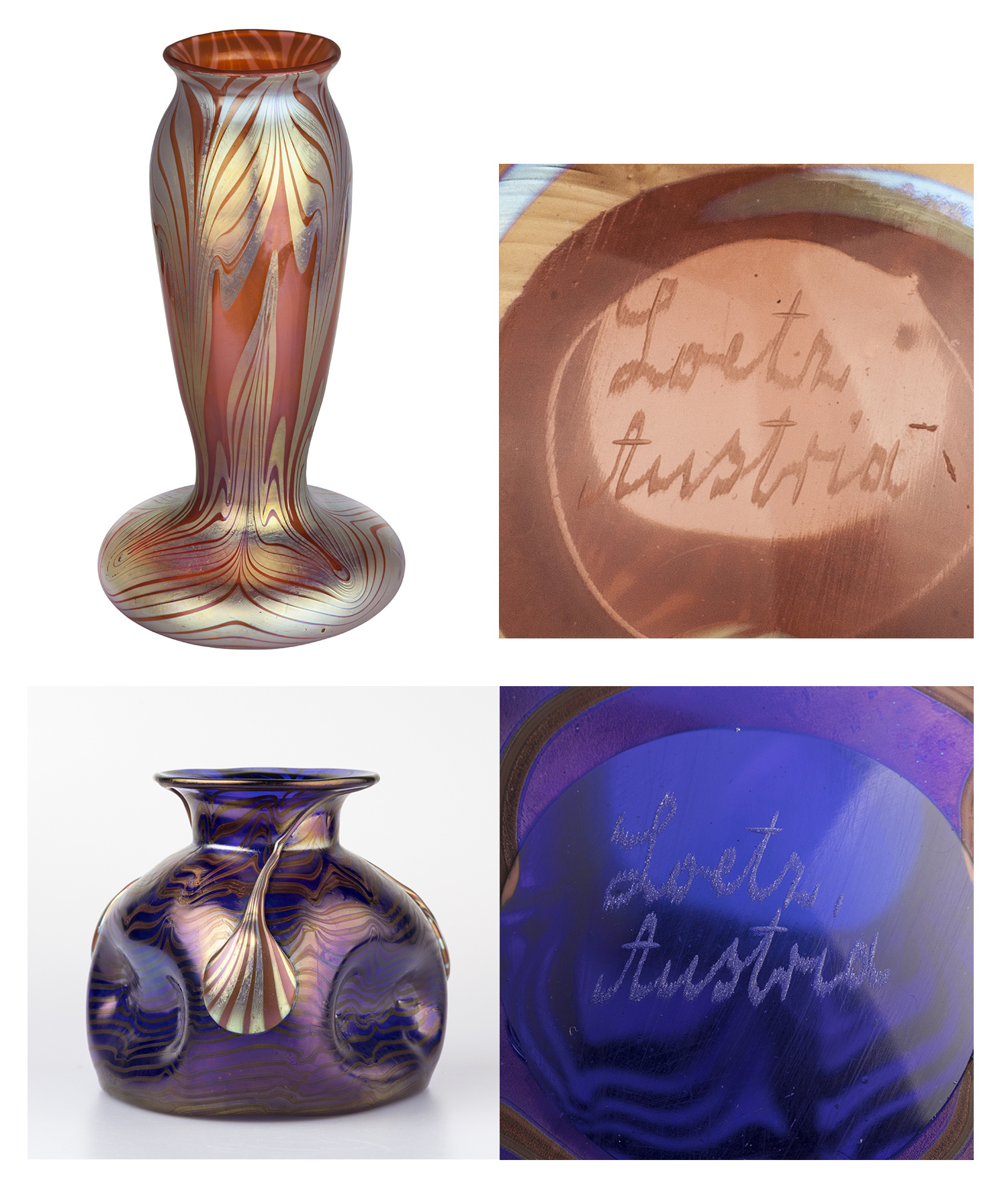
The heyday of “Phänomen” glass was between 1898 and 1903. Starting in 1904, new Phenomenon decors were created, with few exceptions, exclusively for lampshades. The “Phänomen” glasses are also the ones that—almost exclusively—bear the engraved signature “Loetz Austria.”
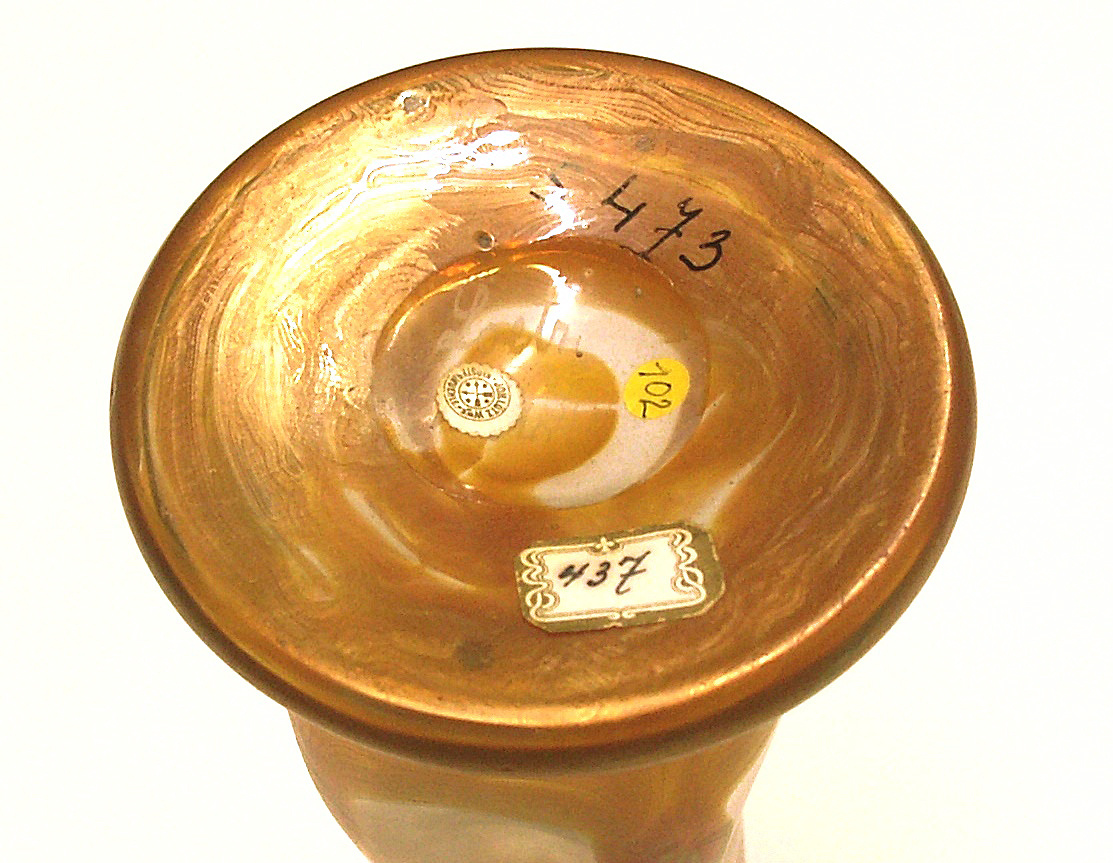
The most reliable source for interpreting signatures are glass objects that entered museum collections as documented contemporary acquisitions and that, in addition to their permanent signatures, still bear the original labels with the company logo, production number, and price. Since the advent of the internet, digital marketplaces, and online auctions, researchers now have access to a virtual repository containing tens of thousands of items from the Loetz Glass Factory. Here we must first separate the wheat from the chaff and work our way through forgeries, misrepresentations, and errors to arrive at the essential information. While the museum pieces reveal what is signed and how, the virtual collection also lends itself to the opposite approach: What was clearly not signed?
I must make it clear from the outset that while the following new arguments are well-founded, they are not based on irrefutable facts, as no original documents are currently available. It is not even known whether there were any clear regulations regarding the use of signatures at the Loetz glass factory. Furthermore, collectors must be aware that rules derived from the examined glass inventory are always subject to exceptions.
Will be continued.
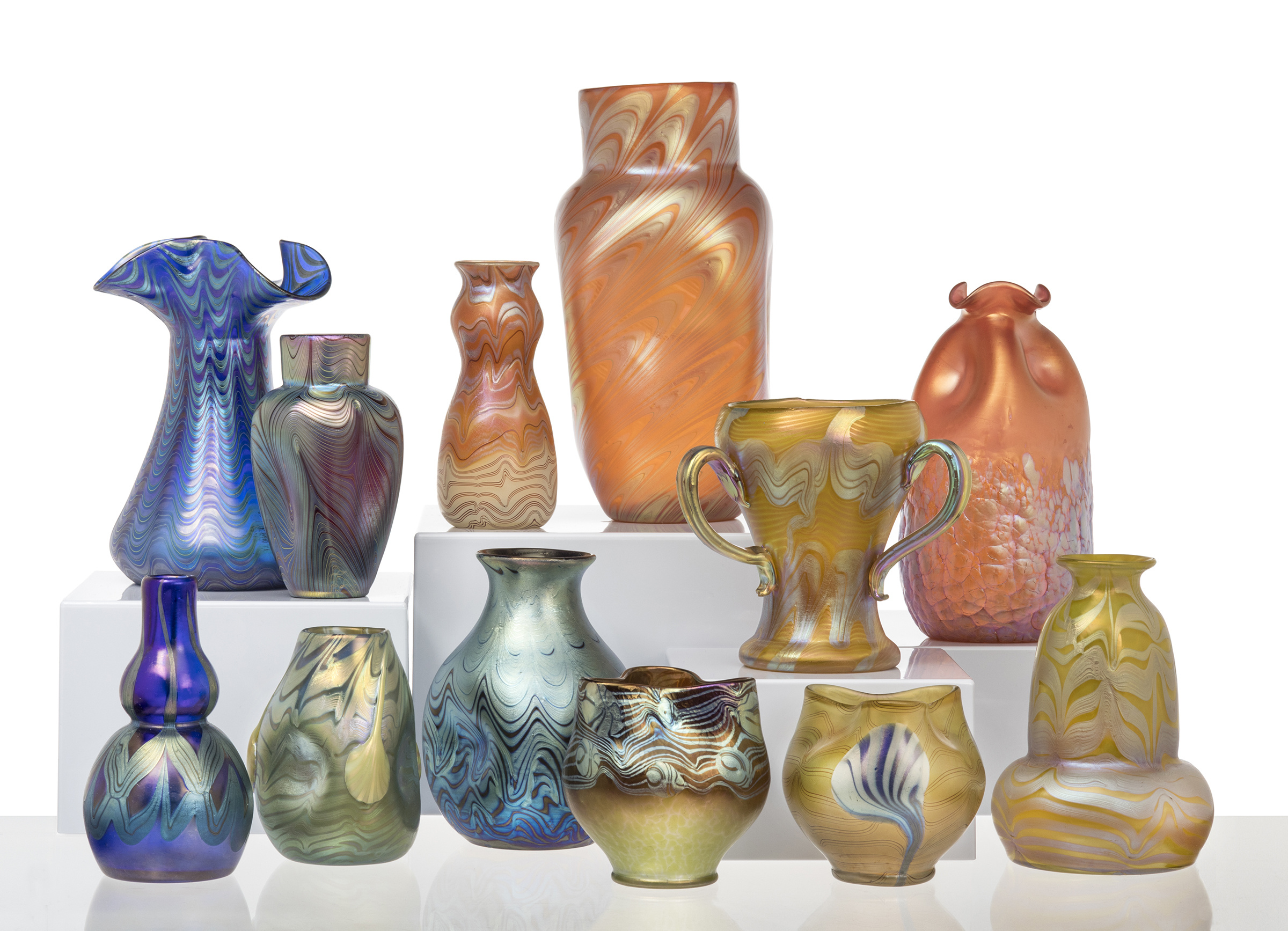
Fig 1: Various phenomenon glasses by Johann Loetz Witwe from the period 1898 to 1903 – clockwise from the top left: dunkelblau (dark blue) Phänomen Genre (PG) 6893, signed „Loetz Austria“; rubin (ruby) PG 7993, unsigned; „thea mit rot (thea with red) Gre 1/728“, signed „Loetz Austria“; „metallrot (metallic red) PG 7624“, signed „Loetz Austria“; Three-handled vase citrongelb (lemon yellow) PG 1/214, signed „Loetz Austria“; rosa (pink) PG 377, unsigned; citrongelb PG 85/3780, signed „Loetz Austria“; unidentified genre, signed „Loetz Austria“; „maron verl. (chestnut brown spreading) Gre 2/351 Argus“, signed „Loetz Austria“; rubin PG 7966, signed „Loetz Austria“; unidentified genre blue opal with teardrop-shaped applications, signed „Loetz Austria“; cobalt PG 7773, signed „Loetz Austria“.
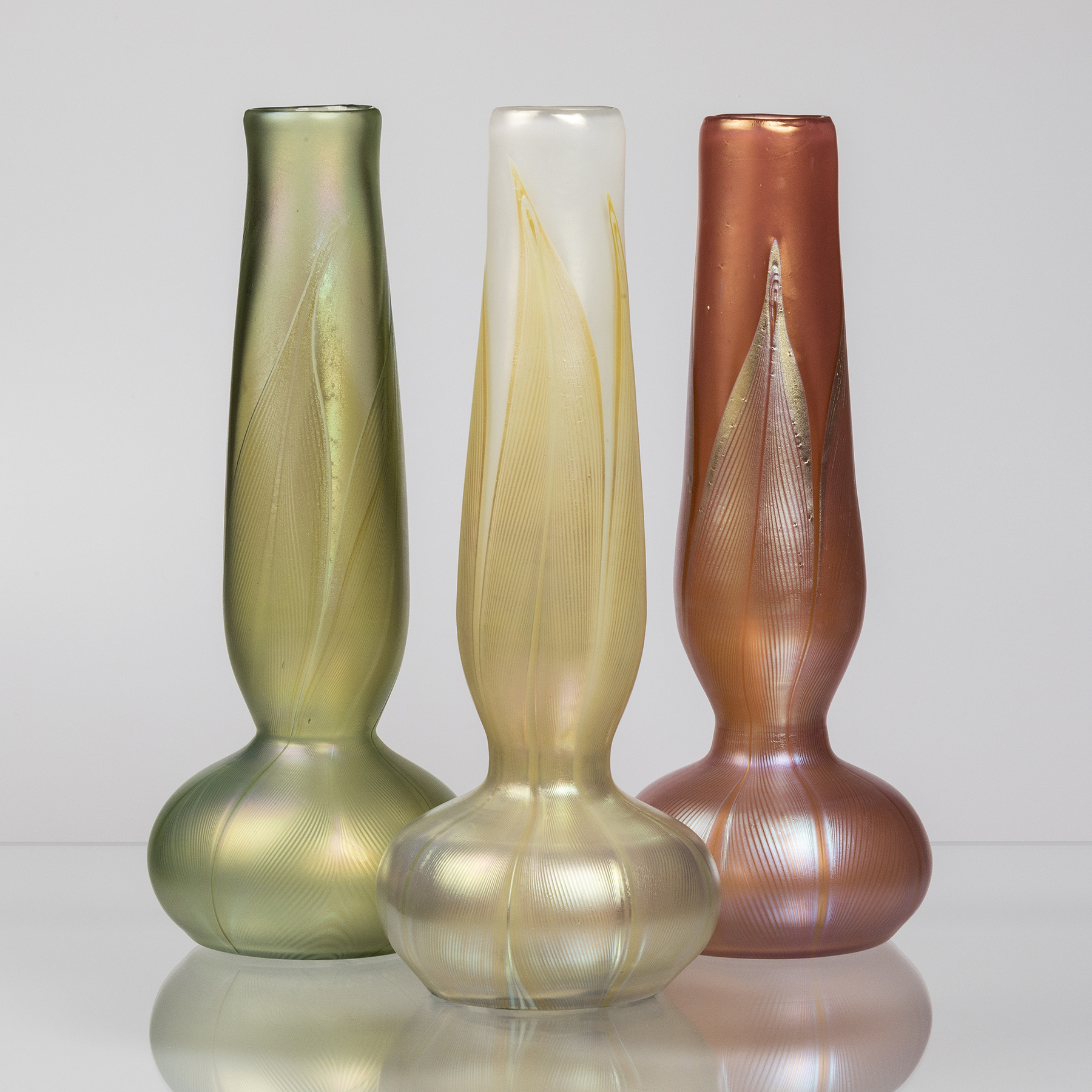
Fig. 2 Three vases „creta“, „opal verlaufend (spreading)“ and „metallrot (metallic red) Phänomen Gre 166“, PN I-7471, 1898, all unsigned. This form marks the beginning of Bohemian Art Nouveau glass.
Fig. 3 Vase „metallrot (metallic red) Phänomen Gre 202“, PN II-203, 1900, authentic signature „Loetz Austria“ and Vase „dunkelblau (dark blue) Phänomen Gre 1/64“, PN II-391, shape from 1900 for the Paris World's Fair, decor 1901, authentic signature „Loetz Austria“
Fig. 4 The base of a vase from the exhibition collection for the 1900 Paris World’s Fair, held at the North Bohemian Museum of Applied Arts in Liberec (Severo?eské muzeum), featuring the engraved signature “Loetz Austria,” an original paper label with the company logo, and an original paper label bearing the production number “437.” Gift from Max Ritter von Spaun to the museum, October 1900.
© Severo?eské muzeum v Liberci, Photo: courtesy of Gabriel Urbanek.
Text and images by Volkmar Schorcht unless otherwise noted.


Fantastic. Thank you so much for your hard work and the translation Volkmar!
Wow, Great!! ! Thanks Danke Glasfreund!