






Posted 23 days ago
 glasfreund
(50 items)
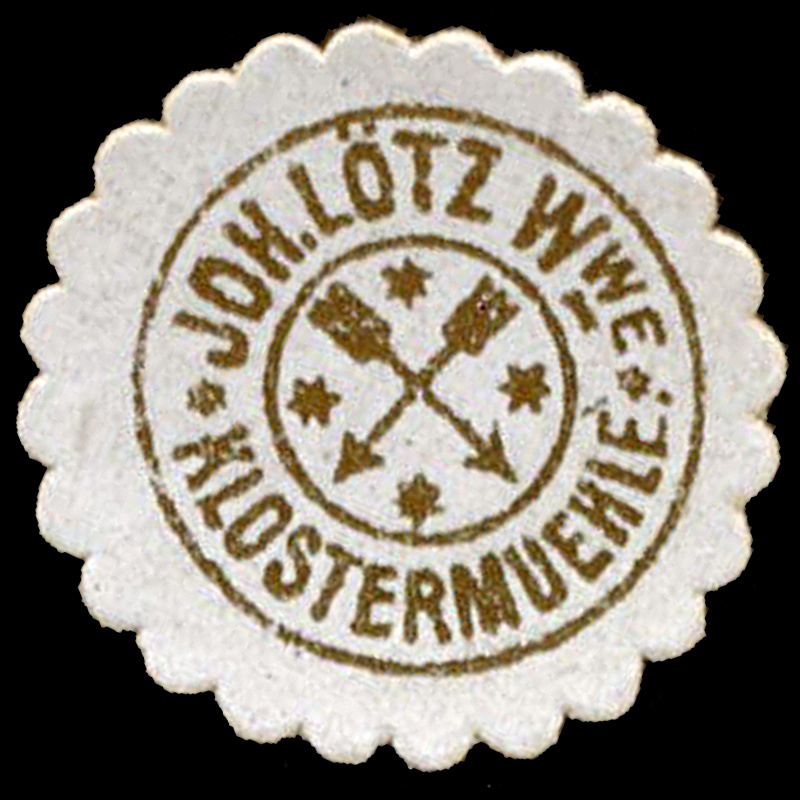
The fact that only a small fraction of the glassware produced by Loetz bears signatures today often leads to the assumption that the glassworks generally did not sign its pieces. This applies only to permanent markings made by engraving, etching, or painting. In fact, we can assume that all art glass pieces that left the factory in Klostermühle around the turn of the century were marked: with a round paper label. Printed on the label was the mark now known as the Spaun circle, crossed arrow, or ring mark, featuring the text „JOH. LÖTZ Wwe • KLOSTERMUEHLE. •“ in the periphery and two crossed arrows with four stars in the center. The latter elements are taken from the Spaun family coat of arms. Spaun had this trademark registered as a figurative mark as early as 1891 and likely used it from that time onward. However, the paper labels did not last very long, as they peeled off over time and when exposed to water. They were therefore primarily intended for sale.
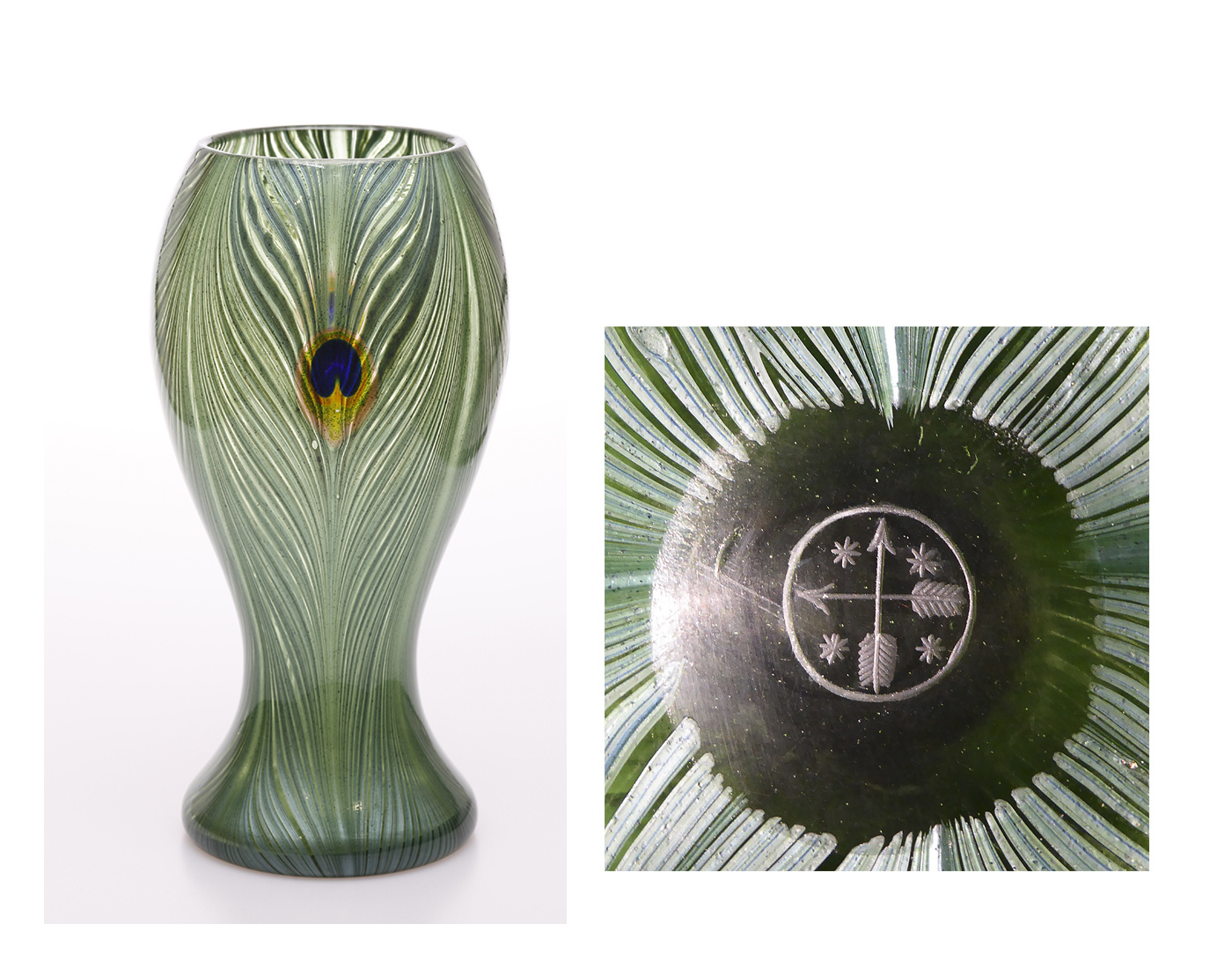
The engraved mark featuring crossed arrows and four stars first appeared in 1898 on glasses that embodied the new style in both form and decor. From 1900 onward, it was used only in a few exceptional cases, such as for gifts.
The engraved Spaun circle mark was apparently used for representational purposes. The engraving appears on the earliest Art Nouveau designs intended for presentation to clients, and is found primarily on glasses that Max Ritter von Spaun donated to museums.
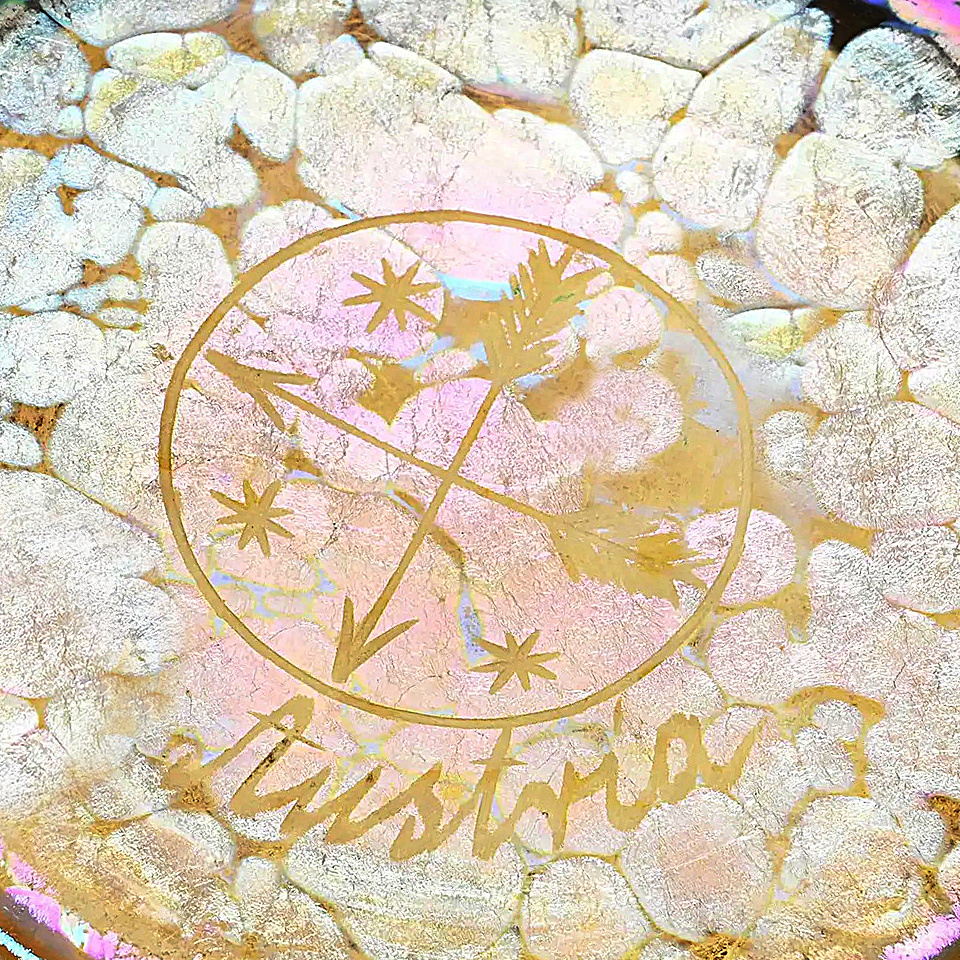
The signatures are generally wheel engraved on the polished-out pontil mark of the glasses. An exception to this are engravings of the circle mark on the base of very simple glasses with “Papillon” decor that lack a pontil mark; these all date from the early days of Art Nouveau glass production in 1898. It is unclear why Loetz signed these simple glasses. They were likely intended for exhibitions and specific clients. This group also includes Papillon glasses from 1898 and 1899 that bear the addition “Austria” alongside the circle mark.
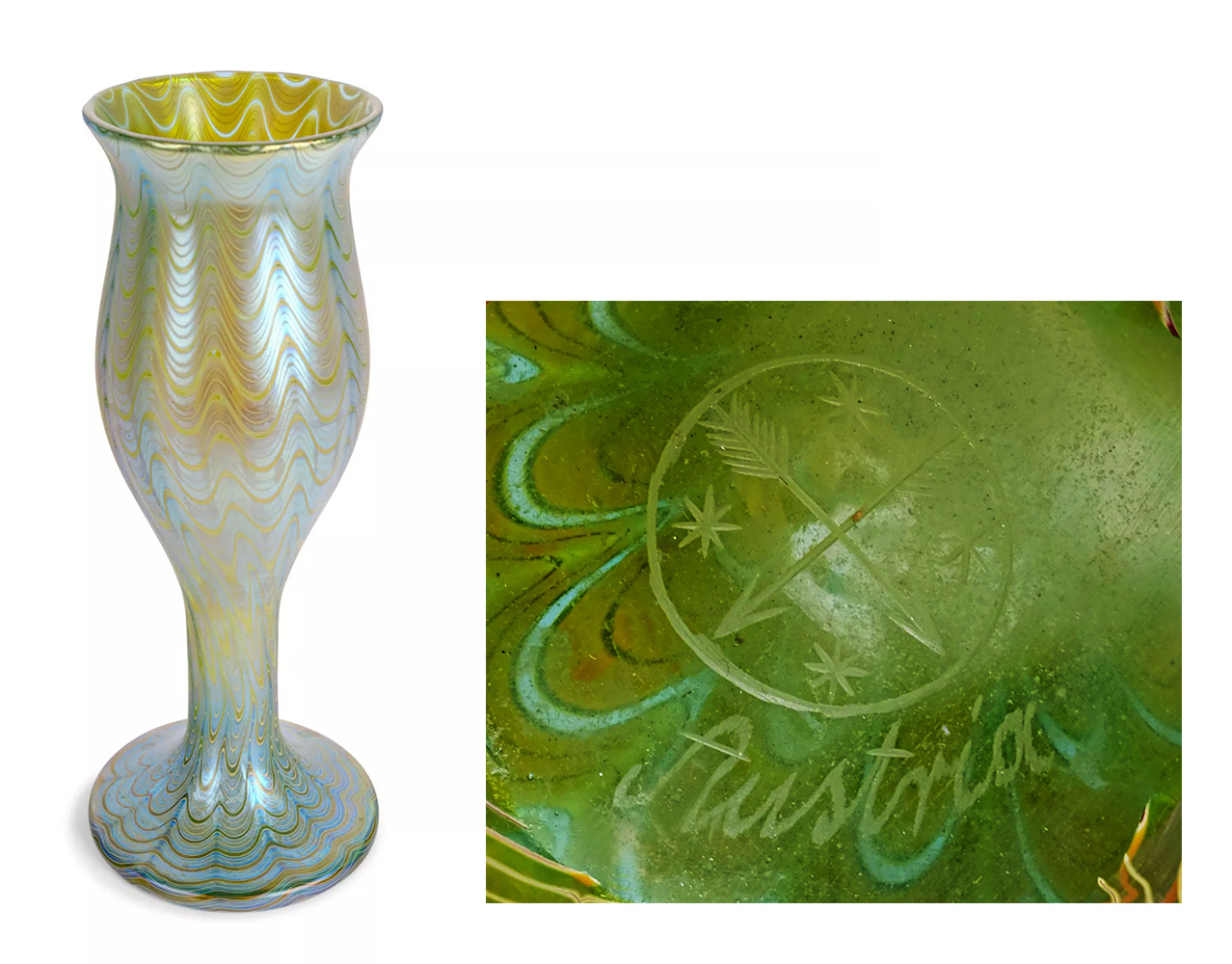
In addition to the affordable Papillon pieces, some Phenomenon glasses from the 1898–1899 period also bear the circle mark with the addition of “Austria.” However, some of these do not rank among the higher-quality products. The reason why the “Austria” addition was engraved here is therefore not evident from the quality. The addition of “Austria” and "Made in Austria" also appeared on ceramic and porcelain products of the time and may well have initially served as an indication of origin. Several pieces with this signature are known for some specific production numbers. Consequently, the signature was applied not only to individual pieces but also to individual production numbers, and possibly to specific orders as well.
Early Art Nouveau glassware donated to the Oberösterreichisches Landesmuseum (Upper Austrian Provincial Museum) in Linz in 1898 bears the engraved inscription “Spaun” in addition to the circle mark. It remains unclear to what extent the "Spaun" addition was used for gifts only.
Will be continued.
Fig. 5 Paper label bearing the company logo. It is likely that around 1900, all of the glassworks’ art glass pieces were marked with this label.
Fig. 6 Vase „Gre Pfauenaugen“ (Peacock Eyes Genre), PN I-7507/10", 1898, Circle mark signature. The peacock-eye pattern is directly inspired by Tiffany glass.
Fig. 7 Circle mark with the addition “Austria” on a simple glass with “Papillon” decor
Fig. 8 Circle mark with the addition “Austria” on a “Phänomen” glass (mountain blue Gre 6893, PN I-7792) from 1999.
Text and images by Volkmar Schorcht unless otherwise noted.
Link to part 1
https://www.collectorsweekly.com/stories/329197-loetz-austria-the-mystery-of-the-signat?in=666-activity


Thanks again for the translation of your article; your research into this subject has been very interesting!